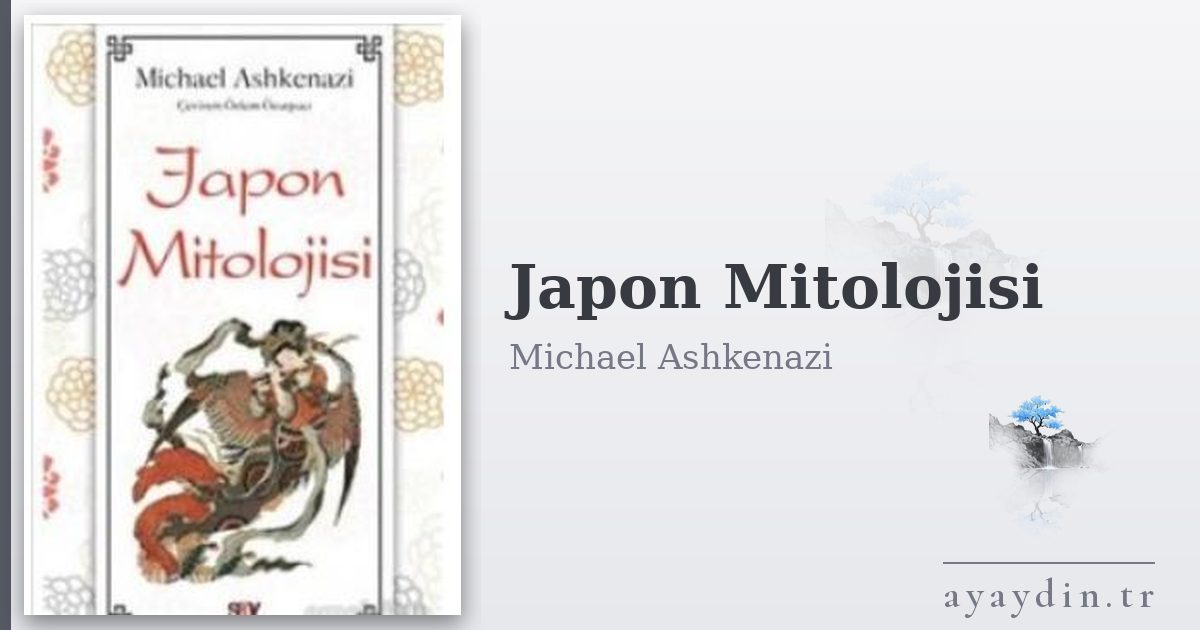
Japon Mitolojisi, Michael Ashkenazi'nin 496 sayfalık eseridir. Aşağıda, Japon Mitolojisi'ni okuyanların en çok paylaştığı cümleler yer alıyor.
Japon Mitolojisi'den En Beğenilen Alıntılar
"dördüncü âlem, yaşamda kötü davrananların olduğu derinlerdeki soğuk bir âlemdi. ister insan, ister kamui olsun, böyle kederli ruhlar, o rutubetli ve karanlık âlemde dolanmaya mahkûm olurlarken düzgün davrananlar, misafirperverlik gösterip ritüelleri gerçekleştirenler yeniden doğmak üzere serbest kalana dek ocak tanrıçası tarafından ocakta saklanırlardı."
📖 Sayfa 115 · Japon Mitolojisi, Michael Ashkenazi
A Buddha is someone who has attained enlightenment and has entered nirvana. A boddhisattva is, by definition originating in India, a being who though capable of attaining Buddhahood, has decided to remain in the Wheel of Life (that is, will be constantly reborn, and has the will and ability to act) in order to assist others to attain enlightenment and start the process toward Buddhahood themselves.
Japon Mitolojisi, Michael Ashkenazi
Çoğu Japon, çaba gerektiren bir sorumluluğun altına girmeden önce gözleri olmayan bir Daruma bebeği alır ve bunun tek gözünü boyar. İkinci göz, ancak sorumluluk yerine getirilince boyanır.
📖 Sayfa 219 · Japon Mitolojisi, Michael Ashkenazi
Japon bakış açısına göre kazanmak her şey demek değildir: Bir tarza sahip bir şekilde savaşmak çok daha önemlidir. Japon mitinin büyük kahramanları genellikle kaybedenlerdir; ancak bunlar gözleri sonuna dek açık kalarak kaybetmiş ve özgün bir tarzda ölmüşlerdir.
Japon Mitolojisi, Michael Ashkenazi
In 1873 the Meiji government of the time dictated the separation of Buddhist and Shinto places of worship. Deities that had been worshiped in dual forms (Ryoobu) as Buddhist and Shintπ deities were now required to be worshiped separately. Over a period of several decades, Shintπ shrines were “rationalized”—assigned rank and income—within a comprehensive state system.
Japon Mitolojisi, Michael Ashkenazi
As a noun, kami means a powerful being with an interest in the lives of humans and the ability to intervene in human affairs, either directly or indirectly, by influencing the activities of other kami, animals, or natural events and features: in short, a deity. As an adjective, the term means something close to “holy”: a mysterious and elevating quality that various living beings, including animals and humans, possess to varying degrees.
Japon Mitolojisi, Michael Ashkenazi
In Japanese social thought, individuals were members of a household, or "ie", before their birth, during their lives, and after death. The dead were expected to be maintained—by worship, offering, and remembrance—by their descendants. When this was not done, the ghost would become dangerous, preying on the living and bringing afflictions such as maladies. The idea perhaps originated in China, but it fit well into the Japanese conceptions of the role of the family.
Japon Mitolojisi, Michael Ashkenazi
There is some internal evidence to suggest that the story of Okuninushi is an alternative myth to the Yamato creation myth. It is conceivable, that the Yamato state cult of Amaterasu and the Izumo state cult of Okuninushi were in competition.
Japon Mitolojisi, Michael Ashkenazi
With the absorption of the Izumo state by the Yamato state to its east, both myths were combined, carefully positioning the Yamato cult deities as sky deities (and thus superior) and the Izumo deities as more subordinate earth deities. This is strongly evident in the myth of the divine rulership of the land.
When a local ruler in the Kanto area, Taira no Masakado by name, rebelled against imperial authority, Tawara Toda went to inspect the rebel, trying to decide whether to support him. He found Masakado eating dinner and agreed to share his meal. As they ate, Toda noticed that Masakado was absently picking up grains of rice he had spilled onto his robes and popping them into his mouth. At that he decided that Masakado was a mean man, unlikely to be generous to his supporters, and he promptly joined the imperial forces and brought about the defeat of Masakado.
Japon Mitolojisi, Michael Ashkenazi
Buddhism differed radically from Shinto in a number of ways. First, it was a
Japon Mitolojisi, Michael Ashkenazi
“revealed” religion. It had a definite founder in the person of Shakyamuni Siddharta, a prince of the Sakya clan in what is now Nepal. Second, it was concerned with personal morality, salvation, and the afterlife. Third, it was a world religion, in the sense that its message was deliberately aimed at all humankind, not at a specific nation or culture.
The mythologies of small villages, and of minority peoples of the Japanese islands—the Ainu and the Ryukyuans—are sometimes not considered, in some fashion, “properly” Japanese or “properly” mythology. Second, even recorded “proper” Japanese mythology—whatever that means—is a compendium of mythologies of local origin and those that come from other traditions, largely India and China, but even the West.
Japon Mitolojisi, Michael Ashkenazi
Indian Buddhism had adapted and built upon the earlier mythological tradition of Hinduism. Many of the chief deities of Hinduism were harnessed as Buddhist figures: lower than the Buddhas themselves, but nonetheless powerful and worthy of respect. Introduced into Japan via China, these figures and deities became figures in Japanese mythology as well, under Japanese names and with Japanese attributes, but clearly sourced from a rich Hindu and Indian tradition.
Japon Mitolojisi, Michael Ashkenazi
Minamoto no Yoritomo was appointed shogun, an ancient military title—somewhat like the republican Roman “dictator”—given temporarily to generals with a commission to suppress Ainu/Emishi forces in western Japan.
Japon Mitolojisi, Michael Ashkenazi
In traditional Buddhist thought (i.e., that of Shakyamuni, the founder of Buddhism), death was a prelude either to rebirth or, if the believer practiced the right path ( dharma), to a condition of Buddhahood where one was relieved from the burden of rebirth.
Japon Mitolojisi, Michael Ashkenazi
In the Japanese view expressed in many myths, winning is not all: Fighting with style is far more important. The great heroes of Japanese myth are often the losers, but they lost with their eyes open and died in style.
Japon Mitolojisi, Michael Ashkenazi
The focus of the Shinsho sect is to show the common person how to be reborn into Amida’s paradise. The way to enter paradise is simply to recite the nembutsu prayer: the formula Namu Amida-butsu, or “Hail Buddha Amida.” The prayer should be repeated as often as possible to ensure salvation, and repetitions of ten or a hundred thousand during a day or week are not uncommon.
Japon Mitolojisi, Michael Ashkenazi
Bu durum Amida'nın sınırsız inayeti ve aktif cömertliği meselesini yok saymaz; ama işte görüyorsunuz ki başarılı dinlerin tutarlı değil sadece yüce olmaları gerekir.
📖 Sayfa 96 · Japon Mitolojisi, Michael Ashkenazi
Ana adalardaki Japon halkın aksine Ryukyular, tuhaf bir biçimde mitolojiye ilgi duymayan bir halk olarak neredeyse tüm araştırmacılar tarafından kayıt altına alındılar.
📖 Sayfa 108 · Japon Mitolojisi, Michael Ashkenazi
Pek çok modern Japon için mitler ve yaşam arasında karmaşık bir ilişki vardır.
📖 Sayfa 24 · Japon Mitolojisi, Michael Ashkenazi

Ainu dinini anlamak için iki temel kavram vardır: ramat ve kamui. Ramat, hem bitki hem hayvan tüm canlı varlıkların ve özellikle de insan ırklarıyla bağlantılı objelerin sahip olduğu içkin güçtür.
📖 Sayfa 112 · Japon Mitolojisi, Michael Ashkenazi
A well-known example of the effects of yakudoshi(momentous years) is that of girl children born in the year of horse-fire. Believed to be destined to become widows, few men will marry them. As a consequence, the Japanese birthrate in those years is far lower than in previous or subsequent years, as many couples avoid having a child for fear the baby would be a girl, and thus unmarriageable.
Japon Mitolojisi, Michael Ashkenazi
The local religion was based largely on the veneration of, and appeal to, local spirits that resided in material objects, usually natural or peri-natural. Mountains, unusual trees, waterfalls, water, peculiarly shaped rocks, and other objects were considered to have a power— kami—of willfully influencing people’s lives.
Japon Mitolojisi, Michael Ashkenazi
Buddhism was formally introduced into Japan in the sixth century from Korea in an attempt at political and cultural pacification. The king of Paekche, a Korean kingdom with linguistic, cultural, and blood ties to the Yamato court, sent several Buddhist images, a number of teachers, scrolls, and artists to the Yamato court. This was an attempt to mitigate the raids of Japanese corsairs on Korea, as well as to initiate closer political and military cooperation against the rising power of Silla, Paekche’s rival on the peninsula.
Japon Mitolojisi, Michael Ashkenazi
'..ilgi çekici temalardan ikincisi de ölümünden sonra bile çocuğuyla ilgilenen "hayalet anne" dir. tatlıcı dükkânına gelerek yerel şekerlemelerin özel bir türünü satın alan bir kadın, dükkân sahibi tarafından gizlice gözlemlenmişti; ardından dükkân sahibi, kadını mezarlığa kadar takip edince, bir cesedin yanında şekerlemeyi huzur içinde emen bir bebekle karşılaşmıştı. benzer hikâyeler japonya'nın her yerinde duyulabilir. '
📖 Sayfa 244 · Japon Mitolojisi, Michael Ashkenazi
Buddhas have no interest or need to intervene in mundane affairs: They have no desires nor wants. To overcome the need people have for help in their daily lives, Buddhist thinkers came up with the idea of the boddhisattva: someone capable of achieving Buddhahood, who has decided to delay this state in order to assist in the salvation of others.
Japon Mitolojisi, Michael Ashkenazi
toprak, bütün olarak oldukça verimlidir ve eski dönem japonlar ve onların soyundan gelen modern japonlar haklı olarak ülkeyi bolluk ve bereket kaynağı olarak görürler; tarihi kıtlıklara ve verimsiz kayalık alanlara rağmen bu genellikle de doğrudur. topoğrafya aslında o kadar da cömert değildir. bir japon deyişi, "kowai mono yotsu: jishin, kaji, kaminari, oyaji" (dört korkutucu şey vardır: deprem, yangın, gök gürültüsü ve baba), doğanın cömert olduğu kadar korkutucu da olduğu (ve elbette baba figürünün herkesin yaşamındaki baskın figür olduğu) düşüncesini örnekler.
Japon Mitolojisi, Michael Ashkenazi
In the familial realm, the feeling still persists among a large segment of the population that the Japanese are special because each family is the bunke (branch house) of the imperial family, and thus descendant from the heavenly deities.
Japon Mitolojisi, Michael Ashkenazi
..ölüler yaşamda olduğu gibi salonlarda bulunurlar. eğer varsa, çektikleri azap eski yaşamlarından ve özellikle de sevdiklerinden ve dostlarından ayrı kalmaktır. ne başka bir azabın olduğuna ne de yomi diyarı'nın bir ceza mekanı olduğuna dair başka bir kanıt vardır. yomi sadece, kimsenin geri dönmediği mutlak kirlilik mekânıdır..
📖 Sayfa 173 · Japon Mitolojisi, Michael Ashkenazi
Ryukyuan religion is one of the few female-centered religions in the world: The majority of ritual specialists (priests and mediums), and all the senior ones, are female.
Japon Mitolojisi, Michael Ashkenazi
The three last—Amaterasu-oo-mikami, Tsukiyomi-no-mikoto, and Susano-wo—were especially blessed and so were assigned the rule of heaven, night, and the ocean. All the kami obeyed their father’s orders and took up the duties of their office, except the last, Susano-wo. He lamented the loss of his mother, Izanami, and as a consequence was reassigned by his furious father to rule over Yoomi(the underworld).
Japon Mitolojisi, Michael Ashkenazi
In Jigoku, the Buddhist hell, the sinful and unrepentant dead are tormented by demons until the time of rebirth. The demons are managed by ten kings headed by Emma-O.
Japon Mitolojisi, Michael Ashkenazi
The very foundations of Japanese culture were based on the importation of Chinese ideas, and later, by Emperor Ojin in particular, of whole families and clans of craftsmen and experts from Korea (this was important enough to have Ojin deified as Hachiman, kami of culture). These imports forced a wholesale rearrangement of archaic Japanese society, just as the importation of Buddhism some years later, the arrival of the Mongols centuries later, and the arrival of the Europeans almost a millennium later did.
Japon Mitolojisi, Michael Ashkenazi
The myth of the brother-sister founder can be found throughout the island chains south of the Japanese islands all the way to the Philippines. The stories are, if we discount ecological and cultural differences, very similar. It is reasonable to speculate, under those circumstances, that somehow or other these stories come from a common source or sources, and that they have arrived either by contact between peoples or because the same people have spread throughout a much greater geographic area than is known today.
Japon Mitolojisi, Michael Ashkenazi
The future Buddha is to rise as the savior once the time is ripe. In this view, Shakyamuni, the historical Buddha, was one of a long chain of Buddhas extending through past ages. Having brought the way of enlightenment to humankind, he departed to his own nirvana. In some Buddhist schools, however, this posed a problem of salvation in later ages. The coming of the boddhisattva Miroku solves this problem by promising the possibility of salvation in the future.
Japon Mitolojisi, Michael Ashkenazi
Izanami died after giving birth to the fire deity, who burned her genitals as he was born. In her dying throes she gave birth to many other deities, created from her organs and discharges. In total she gave birth to fourteen islands and thirty-five deities. The enraged Izanagi killed the newly born fire deity. The dead fire-deity’s organs yielded more deities, as did the blood collected on Izanagi’s sword.
Japon Mitolojisi, Michael Ashkenazi
Hootei is depicted as a fat, jolly, bald priest with fat pendant lucky ears. He may be surrounded, or climbed on, by laughing and playing children. His most important asset is the sack ( hootei) from which he takes his name. It is full of treasures that he dispenses, Santa Claus–like, to deserving children. He also carries a large rigid Chinese fan, with which he can waft happiness onto those surrounding him.
Japon Mitolojisi, Michael Ashkenazi
Battabara was an Indian monk who attained enlightenment in the bath. He was entering the bath with seven other monks when he suddenly, being between pure and impure (one foot in the water, one outside), experienced enlightenment. Battabara thus became the patron of bathing, and his figure (or a board with his name), usually carrying the stick used to stir the warm water, is kept in every bathroom in Zen monasteries.
Japon Mitolojisi, Michael Ashkenazi
The blood-red seeds of the pomegranate are said in Japan to represent the human flesh Kishimoojin used to consume as an ogress. As a consequence, many Japanese will refuse to eat pomegranates because they say the fruit tastes of human flesh.
Japon Mitolojisi, Michael Ashkenazi

Houses in which people died, or those associated with death, were polluted and were therefore, if at all possible, erected for the purpose, then torn down again.
Japon Mitolojisi, Michael Ashkenazi
One consequence of this custom, prevalent in pre-Nara Japan, was the constant movement of the Yamato capital, which occurred whenever a reigning monarch died. This was observed until the foundation of Nara in the sixth century C.E.
According to Amidists, humans are too weak and foolish to save themselves, and only reliance on Amida’s boundless mercy can bring them into his paradise.
Japon Mitolojisi, Michael Ashkenazi
Katakana, was invented to simplify reading Buddhist scriptures for women, who were considered too weak-minded to read proper Chinese characters.
Japon Mitolojisi, Michael Ashkenazi
The rural warriors—referred to somewhat contemptuously as samurai (temple servitor)—hardened by fighting among themselves and by wars of subjugation against the Emishi (Ainu tribes on Honshu) and the Kumasoo (other native tribes in Kyushu), were hard to control.
Japon Mitolojisi, Michael Ashkenazi
Tendai also recognizes four paradises, each one for a different type of inhabitant. There is a paradise in which ordinary people and saints live together, there is a paradise of those who have freed themselves from rebirth and attained personal nirvana, there is a paradise for boddhisattvas, and there is the final paradise of Dainichi Nyorai, inhabited by Buddhas and those who have rid themselves of ignorance.
Japon Mitolojisi, Michael Ashkenazi
The lotus flower reproduces in water without being anchored to earth.
Japon Mitolojisi, Michael Ashkenazi
Therefore it represents the absolute and irreducible truth, as well as the self-engendered nature of the Buddha and the Buddhist Law. More than any object it symbolizes the Buddha as an object/being sui-generis, requiring no explanation or interpretation. The eight-petalled lotus flower represents the Buddhist Law, and Buddhas are usually represented seated on a lotus flower.
Crows were generally birds of good omen. The giant eight-lengths crow Yatagarasu was sent by the heavenly deities to guide the future first emperor Jimmu Tenno, on his way from Kumano to Yamato.
Japon Mitolojisi, Michael Ashkenazi
Perhaps the most important jewel in Buddhism is the diamond. The hardness and brilliance of this stone was well known to the Indians, and the early Buddhists viewed the diamond as emblematic of enlightenment and the role of the Buddhist Law: illumination, essentially unchangeable.
Japon Mitolojisi, Michael Ashkenazi
The Heian period was a period of intense cultural flowering. Poetry, painting, literature, and ritual flourished. The world’s first novel, Genji monogatari (Tale of Genji), was written in this period by a court lady.
Japon Mitolojisi, Michael Ashkenazi
Tenjin's promotions (he was upgraded a number of times) were due to calamities that beset the imperial capital at Heian after the death in exile of a courtier, Sugawara Michizane. Sugawara was then deified as the kami Tenjin, and when the calamities did not stop, he was upgraded in rank until he appeared satisfied, and the plagues and fires ceased.
Japon Mitolojisi, Michael Ashkenazi
The one common major feature of hell is the dry riverbed that runs through it. In this foggy plain are the souls of innocents such as aborted children, who have noone to assist them in their climb to better realms.
Japon Mitolojisi, Michael Ashkenazi
Though Japanese culture has, at least since the injection of Chinese culture, been intensely male-oriented, Japanese myths contain a number of instances of female heroes.
Japon Mitolojisi, Michael Ashkenazi
What is common to all these myths is their tragic overtones: In almost all cases, the woman ends up either being killed or being made the property of an eventual victor.
Several “tribes” of nonhuman creatures also populate Japanese myths. The four most prominent of these are gakki (ghosts), tengu (forest goblins), oni (demons), and kappa (water sprites).
Japon Mitolojisi, Michael Ashkenazi
Yoomi is described as a dark and gloomy land, usually “down below,” where the dead continue their existence amidst centipedes and rot and other polluting things. Yoomi does not appear to be attached to any idea of sinfulness or punishment, and aside from its general gloominess, there is no specific idea of hell as any more than a continuation of existence.
Japon Mitolojisi, Michael Ashkenazi
After they had spent no more than one night together, Koonoohanasakuya-hime became pregnant. Her husband accused her of infidelity with one of the earth deities, for, after all, how could she have become pregnant after only one night of marriage? She proved her innocence by setting fire to the parturition house, from which she and the baby emerged unscathed.
Japon Mitolojisi, Michael Ashkenazi
Called Sumi in Japanese, Mt. Meru is the mythical and physical representation of the universe in Buddhist thought. The roots of this mountain lie in hell, where the souls of those who have done evil in their life suffer torment until they expiate their sins or acknowledge the mercy of Buddha (depending on Buddhist sect). On its flanks toil those who are on the path, the way to achieve Buddhahood. The upper slopes contain the domains of the various Buddhist deities, with their armies, attendants, subordinates, and servants: a giant host of hosts.
Japon Mitolojisi, Michael Ashkenazi
Kenash Unarabe’s fondness for blood makes her, paradoxically, important to the Ainu. She is invoked during rituals for a birthing mother, and for menstruating women, to come and remove the pollution, her reward being drinking the flowing blood.
Japon Mitolojisi, Michael Ashkenazi
Far more serious is fox possession. Possessed people bark, eat from dishes on the floor, and are fearful of dogs. They may be successful at the expense of their neighbors, and were thus shunned and attacked in Japan until recently. In some recorded instances whole families were extirpated because they were suspected of being fox-possessed and thus preying upon their neighbors.
Japon Mitolojisi, Michael Ashkenazi
In addition to Koonoohanasakuya-hime (Flower-blossom princess), the father also gave the bridegroom his older daughter, the ugly Iwanaga-hime (Long-rock princess). The divine grandson returned the ugly sister, and her ashamed father said: “I gave my two daughters to the divine grandson to ensure his life would last as long as the rocks, and as flourishing as the blossoms of the trees. He has rejected Long-rock princess, and therefore his prosperity and life shall be as evanescent as the blossoming of the trees.” And indeed, from that day on, the emperors have never lived very long.
Japon Mitolojisi, Michael Ashkenazi

Izumo’s connection with wizardry and the underworld are evident throughout the myths about it. They arose, perhaps, because the Yamato, in common with other societies, assigned to their most powerful opponents the label of wizards and necromancers.
Japon Mitolojisi, Michael Ashkenazi
Before undertaking an effortful commitment, many Japanese will acquire a Daruma doll with blanks for eyes, then paint in one eye. The second eye is painted in only when the commitment has been accomplished. Collections of seven such small dolls can be bought, with reference to the idea that even Daruma is reputed to have failed six times before succeeding in the seventh try in reaching enlightenment.
Japon Mitolojisi, Michael Ashkenazi
The hearth, Kamui Fuchi's abode, also serves as the abode of the dead, and ancestors are actually known as “those-dwelling-in-the-hearth.” Because the Ainu believe in transmigration, it is the holding place from which new souls are assigned to bodies in the act of human procreation. As a consequence, the hearth must be kept pure; nothing is allowed to contaminate it. At night Kamui Fuchi retires to rest as the coals are covered with ashes, but the fire itself must never be extinguished. So important is her position that Kamui Fuchi never leaves her house.
Japon Mitolojisi, Michael Ashkenazi
Sıkça Sorulan Sorular
Japon Mitolojisi kimin eseridir?
Japon Mitolojisi, Michael Ashkenazi tarafından yazılmıştır.
Japon Mitolojisi kaç sayfadır?
Japon Mitolojisi, 496 sayfadır (Say Yayınları baskısı).
Japon Mitolojisi'nin en ünlü sözü nedir?
“"dördüncü âlem, yaşamda kötü davrananların olduğu derinlerdeki soğuk bir âlemdi. ister insan, ister kamui olsun, böyle kederli ruhlar, o rutubetli ve karanlık âlemde dolanmaya mahkûm olurlarken düzgün davrananlar, misafirperverlik gösterip ritüelleri gerçekleştirenler yeniden doğmak üzere serbest kalana dek ocak tanrıçası tarafından ocakta saklanırlardı."”